Non-Fiction Pick of the Week: The Tanning of America
Stoute draws from his wide background in the music industry and brand marketing to bring us his thesis that hip-hop music is the major change agent in American society today.
Posted by
Good Book Psychic
at
5:31 p.m.
0
comments
Labels: music, Non-Fiction, Social Issues
Bringing Up Bébé by Pamela Druckerman
When American journalist Pamela Druckerman and her British husband Simon decide to settle in Paris and start their family, they begin to notice some big differences between American children and French children. It all starts to dawn on Druckerman when she and Simon take their eighteen-month-old toddler on vacation. As their little girl loses her mind while out for dinner at a coastal restaurant, Druckerman notices the French children are remarkably well behaved and even eating their vegetables!
By researching French parenting experts and interviewing parents on both sides of the Atlantic, Druckerman delves into the major issues and stages of raising young children from the French perspective. From hot topics like breastfeeding, early child care, disciplining children, and more – Druckerman offers the French view, which may seem like a dream come true for North American parents. Told in a humorous, storytelling manner, Bringing Up Bébé illustrates that values surrounding parenting are in many ways a cultural construct, and having alternatives will be appreciated by many parents and may be beneficial to the entire family.
Posted by
Good Book Psychic
at
4:04 p.m.
0
comments
Labels: Non-Fiction, parenting, Social Issues

June is wedding month! Why not celebrate with:
Marriage, A History: from obedience to intimacy, or how love conquered marriage by Stephanie Coontz 2005
We have been led to believe that the Leave It to Beaver marriage of the 1950s is the most natural. However, if one looks at the institution over the ages, it is but a blip--and not necessarily natural. Throughout the ages, marriage customs have been influenced primarily by politics, economics, and social conditions. Marriages were often arranged to forge alliances between kings and nobles, or to acquire a neighbour’s field. Although love and passion were factors in the affair between Antony and Cleopatra, politics also played a large role. The roles of husbands and wives changed constantly. To be sure, sometimes love entered into the equation and, if lucky, the love was between spouses.
Stephanie Coontz describes the various types of marriages that have existed and the conditions that influenced them. She discusses how they were affected by religion and law, and how marriage, in turn, influenced religious tenets and laws. She often relates anecdotes of arrangements at particular periods in history based on diaries and letters written by men and women of that time.
Ms. Coontz talks about the evolution of marriage through to recent times, when the individual became important, and love in a marriage became a necessary ingredient. She is not judgmental, but presents the advantages and disadvantages of each model. She ends on the hopeful thought that we have learned from the past and that man/woman relationships will be more satisfactory to both.
Posted by
Good Book Psychic
at
5:27 p.m.
0
comments
Labels: Non-Fiction, Social Issues
There are Things I Want You to Know about Stieg Larsson and Me by Eva Gabrielsson 2011
Everyone knows the Millennium Trilogy by Stieg Larsson with the books The Girl With the Dragon Tattoo; The Girl Who Played with Fire and The Girl Who Kicked the Hornet’s Nest. When Stieg Larsson died unexpectedly in 2004, he was just in the process of getting his first book published and didn’t live to see the huge success that his books would become, translated into many languages and made into films, both in his native Sweden and in Hollywood.
What many people do not know is that this was only one facet of his life. Many people do not about his life as an activist and his relentless pursuit for social justice and human rights. Who better to tell this story but his partner of 32 years Eva Gabrielsson. This is a fascinating book about both Stieg and Eva and the incredible life and drive they both shared. Since his death she has struggled to survive without him and to obtain control over Larsson’s literary estate. It is an easy read, written in chapters like snapshots of their life. You will come to appreciate just how truly driven and talented Stieg Larsson was and how together, he and Eva created the Millennium trilogy.
And for those who are interested in knowing more about the fascinating life of Stieg Larsson, swing by the library on January 19th to view the film Millennium: The Story.
This is a free screening. To register, please call 905-639-3611 Ext. 1321.
Posted by
Good Book Psychic
at
10:50 a.m.
2
comments
Labels: Biography, Non-Fiction, Social Issues, Women's Lives
The Typewriter is Holy by Bill Morgan 2010
Bill Morgan’s The Typewriter is Holy: the complete, uncensored history of the Beat Generation is a broad look at all the major literary figures of ‘The Beats’. It is also a no-holds-barred exposé of the radical revolutionaries of the 60s who shook America to its roots. The literary giants with feet of clay have been the focus of Bill Morgan’s career. He was a friend of Lawrence Ferlinghetti from the early days of the City Lights bookstore, and the archivist to Allen Ginsberg. His singular perspective gives us an insider’s view of literary and social history in the making.
Posted by
Good Book Psychic
at
5:23 p.m.
0
comments
Labels: History, Non-Fiction, Social Issues
The Boy in the Moon by Ian Brown 2008
The Boy in the Moon is an intense memoir by Globe and Mail writer, Ian Brown. Brown first introduced readers to his son Walker in a series of articles published in The Globe and Mail and his writings elicited such a response that a book soon followed. In vivid detail, Brown describes what life is like for himself, his wife, his daughter, and his son Walker, who was born with an extremely rare genetic condition rendering him profoundly disabled. The exhaustion, frustration, humour, and love Brown has experienced caring for his son are brought to life here, but this book is far more than a parent’s reminiscences. Brown explores the ethics surrounding how society handles those living with disabilities; he confronts his own guilt as a parent who is unable to provide all the care his son requires, all the while searching for the meaning and value of his son’s life. The Boy in the Moon has won several awards, including the 2010 Trilliam Book Award. It was also a finalist for the Governor General’s Literary Award for Non-fiction. Brown pulls you into his world and it is likely one you’ll never forget.
Posted by
Good Book Psychic
at
1:00 p.m.
0
comments
Labels: Canadian Non-Fiction, Memoirs, Social Issues
The Price of Stones: building a school for my village by Twesigye Jackson Kaguri 2010
This is an inspirational book about a Ugandan man who studied in the United States and returned to his village to build a school for AIDS/HIV orphans in 2003. If you liked “Two cups of tea “you will enjoy this book. The author saw a need in his community and he and his American wife , family and friends did fund raising and applied for grants to build a two- room school house to provide free schooling and uniforms to HIV/AIDS orphans in his village of Nyakagyezi. By 2008 the school had grown to accommodate eight primary classrooms and had obtained funding to pay the tuition cost for the first year of secondary school for the grade 8 graduating class. (Primary and secondary education is not free in Uganda).
For your consideration: The author is a Seventh Day Adventist and so there are some sections that speak of his faith and there are sections that have verses from the New Testament.
Posted by
Good Book Psychic
at
1:46 p.m.
0
comments
Labels: International Issues, Memoirs, Non-Fiction, Social Issues
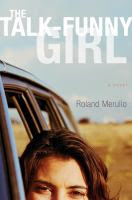
The Talk-Funny Girl by Roland Merullo 2011
Marjorie is the seventeen-year-old “talk funny” girl whose first person recollection of her upbringing in a poor rural area of New Hampshire is the basis of this compelling novel. Her parents are completely isolated from the community with their own mountain hybrid dialect that makes Marjorie a subject of teasing at school and abuse at home. Her distrust of adults is well entrenched, learned from the actions of her parents and a sadistic minister, and heightened by the unsolved abductions and murders of several young girls. Only the kindness of an aunt and a young stoneworker, with a dream of building a “real cathedral” out of the debris of an old church, can save her.
This novel is captivating, the suspense low grade but building to an unexpected ending It is apparent from the opening chapter that Marjorie, with her inspiring resilience, finds her way out of this hopelessness. Having lost her dialect as an adult, she is aptly able to express herself: “I wanted to go back and hunt it down and close the hurt museum for good though I discovered you cannot really do that. What you can do, what you have to do is not pass much of it on.” It is a journey and a moral lesson the reader will remember.
Posted by
Good Book Psychic
at
1:38 p.m.
0
comments
Labels: Coming of Age Fiction, Family Relationships, Social Issues
Posted by
The Book Psychic
at
2:16 p.m.
1 comments
Labels: Canadian Non-Fiction, Memoirs, Social Issues

Annabel by Kathleen Winter
Annabel, a nominated title for the 2011 Ontario Library Association Evergreen award,is an edgy novel about a child who was born a hermaphrodite to a family in a small community in Labrador. The baby’s father, Treadway, wants the child to live his life as a male while his mother, Jacinta, feels that the baby is truly her daughter.
The child is brought to a surgeon who follows the wishes of the father.
The baby is christened Wayne. Wayne has a difficult life living in a male body that requires pharmaceutical interventions to mask his dual sexuality.
Wayne has one true school friend, Wally Michelin, who wants to pursue a career as a classical music singer. A tragic accident results in Wally’s vocal cords being injured. Wayne, on the other hand,is interested in bridges and architecture.
What I liked about the book is that both Wayne and Wally are able to achieve their life dreams regardless of the struggles that they have to endure. The novel has many well-developed characters and aptly portrays the struggles of Wayne, Treadway, Jacinta and Wally. Annabel was nominated for the Evergreen Award, the Governor General's Award and the Scotiabank Giller Prize.
Posted by
The Book Psychic
at
7:02 p.m.
0
comments
Labels: Canadian Fiction, Coming of Age Fiction, Evergreen Nominee, Social Issues, Strong Characterization

Born Digital: Understanding the First Generation of Digital Natives by John Palfrey and Urs Gasser 2008
A thought-provoking read for parents and educators of “digital natives”—those born after 1980 who do not remember a time before computers and the Internet. This generation experiences information, creativity, control, privacy, and friendship differently and therefore present unique challenges and opportunities. The authors offer a balanced approach cautioning against over-reaction and counseling common-sense in guiding both generations through this transition period. As part of a the Digital Natives project affiliated with Harvard University, there is an accompanying website with links to a wiki, blog, and bookmarks to encourage further discussion, as well as a presence on YouTube, Facebook, and MySpace. If you don’t know what those things are, you should probably read the book!
Posted by
The Book Psychic
at
10:37 a.m.
0
comments
Labels: Non-Fiction, Social Issues

Nine Lives: death and life in New Orleans by Dan Baum 2009
Nine Lives provides a unique perspective on the disaster that was Hurricane Katrina. By profiling the lives of nine individuals who lived in New Orleans from 1965’s Hurricane Betsy to the devastation of Hurricane Katrina in 2005, Dan Baum not only provides historical context for Katrina, but also gives you a window into what makes New Orleans so unique, so worth saving, and so difficult to save. The intertwined mini-biographies allow you to peer into the lives of people from different social classes, political orientations, and world views, always pointing back to how New Orleans shapes the people who live there. New Orleans is shown as a city with a culture foreign to the rest of the United States. Baum makes a case for its’ beauty, tradition, and family oriented lifestyle. By the same token, he outlines how its unwillingness to change economic attitudes to keep pace with the rest of the country and a lack of racial integration make it even more difficult to rebuild the city after Katrina. Nine Lives makes for an excellent read for those interested in culture, politics, history, and biographies.
Posted by
The Book Psychic
at
5:12 p.m.
0
comments
Labels: Biography, politics, Social Issues

The Accidental Billionaires by Ben Mezrich 2009
In describing the origin of Facebook, Mezrich has proved that it is possible to write celebrity gossip about both Harvard University and computer geeks. Eduardo Saverin wanted to be selected by one of the elite, all-male Final clubs. His friend, Mark Zuckerburg would have rather written computer code than uttered words. Tyler and Cameron Winklevoss, identical twins, wanted to row in the Olympics. All hoped to grow rich by make socializing easier at Harvard. But only one of them will reap the riches that came with the explosive popularity of Facebook. And he declined to be interviewed. The subtitle summarizes the rest of this story: “A tale of sex, money, genius and betrayal”.
A timely read, as The Social Network, the movie based on this book, has just been released.
Posted by
The Book Psychic
at
4:41 p.m.
0
comments
Labels: Non-Fiction, Social Issues

Among the Mad by Jacqueline Winspear (2009)
This installment in the Post-World War I mystery series finds female psychologist and investigator Maisie Dobbs witnessing a suicide on the streets of London. After being questioned by Scotland Yard, she’s recalled a few days later when her name is mentioned in a letter threatening escalating acts of terror if the government doesn’t extend help to veterans psychologically damaged during the war. Maisie faces her greatest challenge yet as she assists Scotland Yard in the investigation and comes face to face with the plight of those victimized by shell-shock (what we now call Post-Traumatic Stress Disorder). At the same time, a friend is experiencing depression, and Maisie intervenes to save her from the outdated and barbaric treatments often prescribed in the early 1930s.
Jacqueline Winspear’s exhaustive research brings the period to life, and along with delivering a good, complex plot and richly drawn characters, she sheds light on issues we still struggle with today. Each of her novels focuses on a particular aspect of the aftermath of war (the changing role of women, poverty and unemployment in the wake of conflict, or the impact on family members left behind), an approach that will appeal to fans of the Second World War television series Foyle’s War or the mysteries of Charles Todd.
Posted by
The Book Psychic
at
8:06 p.m.
1 comments
Labels: Beans and Books Selection, Historical Fiction, International Setting, Mystery, Social Issues, Women's Lives

Nothing to Envy: ordinary lives in North Korea by Barbara Demick 2009
Award-winning journalist Demick offers a never-before seen view of a country mostly unknown to the rest of the world. She based the book on interviews with the defectors from the city of Chong jin.
The book is about the lives of real six people who have families and try to make a living in a country with a totalitarian regime. The human rights issues and daily life in North Korea is a tragedy that is taking place out of Western public view, while the news headlines focus on North Korea’s nuclear ambitions.
Demick says at the end that the defectors find it hard to settle in South Korea. They are overwhelmed by the choices facing them. Many feel guilty about leaving family members behind and would like to return home.
The stories are moving and disturbing and tell us more about North Korean lives than the staged tourists visits to the capital city. The title is from a song the North Korean children are taught to sing: “Nothing to envy in the world” - this while struggling to survive and slowly dying of starvation.
Posted by
The Book Psychic
at
9:00 a.m.
0
comments
Labels: Economics, International Issues, Social Issues

SuperFreakonomics
by Steven Levitt and Stephen Dubner 2009
This is the sequel to the best-seller Freakonomics, in which University of Chicago professor of economics Steven Levitt and author Stephen Dubner teamed together to apply economic reasoning to a wide range of real-world questions. As in the original, the situations explored in SuperFreakonomics are based on accumulated data, not anecdotes or anomalies. Statistical techniques are applied to such unconventional topics such as drunk walking, prostitution, honesty in psychological testing, and doctors' resistance to washing hands. They go beyond simply reporting their observations, to suggest that solutions to apparently intractable problems appear both "out of nowhere" and as a result of self-interest. For instance, the the problem of too much horse manure in American cities was solved by the introduction of gasoline automobiles. Similarly, the problem of climate change will only be solved when we base our choices on self-interest. Kyoto's appeals to our consciences are not incentive enough endure the inconvenience of changing our habits.
The authors have a gift for explaining clearly how a researcher reaches their conclusions, making the writing not only entertaining, but factual.
Posted by
The Book Psychic
at
4:03 p.m.
0
comments
Labels: Economics, Social Issues

This Land is Their Land : Reports From a Divided Nation by Barbara Ehrenreich
This Land is Their Land : Reports From a Divided Nation is a collection of previously published essays about the growing gulch between the haves and have-nots and what used to be the middle class in America. Full of wit and irony, the author, Barbara Ehrenreich analyzes how wealthy individuals and corporations are sadly broadening the gap by engineering social, political, and economic policies that continue to disadvantage the middle class and poor. She also darkly diagnoses other issues including illegal immigrants, military families, unemployment, health insurance, corporate spying, cancer, and more. It’s a real eye opener on a theme that is being touted more and more in the U.S. (and Canada!). Read an essay or two, give yourself time to digest the information, then try a few more. Most of her arguments are sound, her presentation easy to absorb.
Posted by
The Book Psychic
at
1:21 p.m.
0
comments
Labels: Non-Fiction, Satire, Social Issues